The Empty-Plaza Myth: Why Open Space Can Feel Uninviting
Why can an open plaza feel uninviting? See how edges, shade, seating, and visible activity help people read the space and choose where to pause.
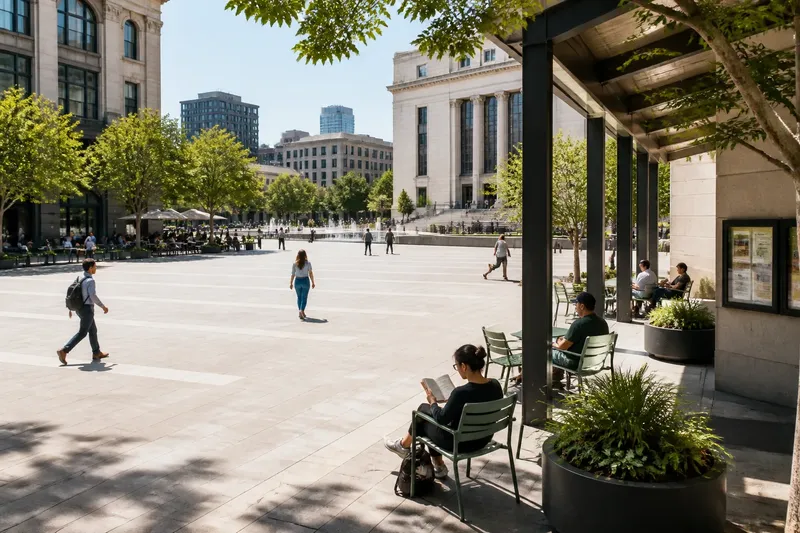
Why can a wide, unobstructed plaza feel harder to enter than a narrow park path? An open plaza feels inviting when people can read where to go, where to pause, and what they might do there. Clear ground is useful, but emptiness alone offers little guidance.
Think of a plaza as a public room without walls. Its edges, furniture, shade, and visible activity act like signals: they tell a passerby whether stopping is comfortable and whether anyone else is welcome to do the same. When those signals are weak, people may cross quickly, even if the space is technically open to everyone.
Open ground, unclear invitation
Designers often leave a central area unobstructed to support markets, performances, gatherings, or simply an uninterrupted view. That flexibility can be valuable. Yet a large clear surface may also leave people unsure whether they are meant to walk through, linger, or stay out of the way.
The first question is not simply how much open ground a plaza has. It is whether someone approaching can recognize a comfortable place to enter and settle without blocking movement or becoming the center of attention. A bench tucked against a wall, a tree canopy near the path, or a small group gathered around a fountain can make that choice more legible.
Open space can also make small numbers of people feel conspicuous. A lone person sitting near the middle of a broad paved area may appear exposed, while the same person beside a planted edge feels sheltered by the setting. That difference is not about hiding people; it is about giving them a few choices for how visible they want to be.
Edges make room readable
People often judge a plaza from its perimeter before deciding whether to enter. Building fronts, arcades, low walls, planting beds, steps, and kiosks can create a sense of enclosure without closing the space. They mark useful places to sit, meet, watch, or pass through.
A blank frontage offers fewer cues than one with doors, windows, and visible activity. A door suggests a destination; a window can show whether a place is in use; an arcade can offer cover while preserving a view across the plaza. None of these features needs to be elaborate. The important point is that the edge gives a person something to relate to besides an expanse of paving.
Edges also shape movement. A route that follows the building line can feel easier to understand than a diagonal crossing with no visible destination. Where several paths meet, paving changes, lighting, planting, or a clear view toward an entrance can help people distinguish the main route from a place meant for sitting.
Comfort is a pattern
Shade and seating work best as part of a pattern rather than as isolated objects. A single bench in full sun may be technically available but uncomfortable during a warm afternoon. A row of seats with no nearby shade may suit some visitors and deter others. Trees, canopies, arcades, and building shadows create different conditions as the sun shifts.
Seating should offer more than one social arrangement. A long bench can support a group, while separate chairs or seat walls let visitors sit alone or face one another. A seat facing a lively path gives people something to watch; one placed beside a quieter edge offers a less exposed pause. Back support and a nearby place for a bag can matter to someone deciding whether to stay.
Surface and access are part of comfort too. Smooth, firm routes help people using mobility aids, pushing strollers, or carrying wheeled bags. A level approach to seats and clear space around them make it easier to join a group without having to negotiate a crowded or uneven patch of ground.
Activity gives cues
Visible activity can make a plaza easier to understand. A café with outdoor tables, a food cart, a chess table, or people watching a small performance all show possible ways to use the space. The activity does not need to fill the plaza. A few points of interest can make its scale feel less daunting and help visitors anticipate what happens there.
That does not mean every plaza needs constant programming. A space that depends on scheduled events may feel empty between them, and too many competing uses can make rest difficult. A better mix leaves room for ordinary routines: meeting someone, eating lunch, resting in the shade, or watching the street from a seat.
Imagine a paved plaza outside a library where passersby keep walking along its outer edge. The city adds several movable chairs under an existing canopy and places a noticeboard near the library entrance. The expected observable result is not a packed square; it is that visitors can see a practical place to pause and a reason to approach, while the main crossing remains clear.
What should visitors notice?
Where is the easiest entrance?
Look for a clear path from the sidewalk into the plaza, ideally with a visible destination such as a doorway, shaded seat, or active edge. If the route seems ambiguous, follow the path other pedestrians naturally use rather than cutting across planted or event areas.
Where can someone sit comfortably?
Check whether seats offer shade, a view, and enough room to approach without crossing the main flow of people. A choice between sociable seating and a quieter edge usually makes a plaza easier to use for different kinds of visits.
What makes the center feel empty?
Notice whether the open middle has a clear purpose, such as a market area, a gathering point, or a view worth crossing toward. If it has no visible destination, the edges may be doing nearly all the work of making the space useful.
Is activity visible from outside?
From the sidewalk, look for people, open doors, a café counter, a fountain, or another sign that the plaza is in use. Visible activity can reduce uncertainty, though a quiet plaza may still be welcoming if its entrances and places to rest are easy to identify.
Useful openness, not emptiness
Some open ground is worth keeping clear. Temporary events need room to adapt, and busy walking routes should not be crowded with furniture. What is not worth the effort is filling every vacant patch with decorative objects just to make the plaza look occupied. Clutter can interrupt movement and make the space less flexible without giving people a more comfortable place to stay.
For a practical read of any plaza, look first at the approach, then the edges, then the places to sit and the activity visible from outside. Those details reveal whether openness serves a clear public use or simply leaves visitors to invent one for themselves.
The empty-plaza myth is not that open space is bad; it is that openness can do the work of welcome on its own. A generous center becomes more inviting when the surrounding space offers legible choices: enter here, rest there, watch from this edge, or keep moving along a clear route.